
The Trap of Over-Optimization in Performance Training
Why chasing perfect movement patterns can reduce adaptability—and how introducing variability builds athletes who perform when conditions are anything but perfect

There’s a quiet trap in performance training that doesn’t get talked about enough: the obsession with optimization.
We chase perfect mechanics.
Perfect programming.
Perfect outputs.
Everything becomes a search for the most efficient, most repeatable, most “ideal” way to move.
And for a while, that works.
Until it doesn’t.
The Problem With “Perfect”
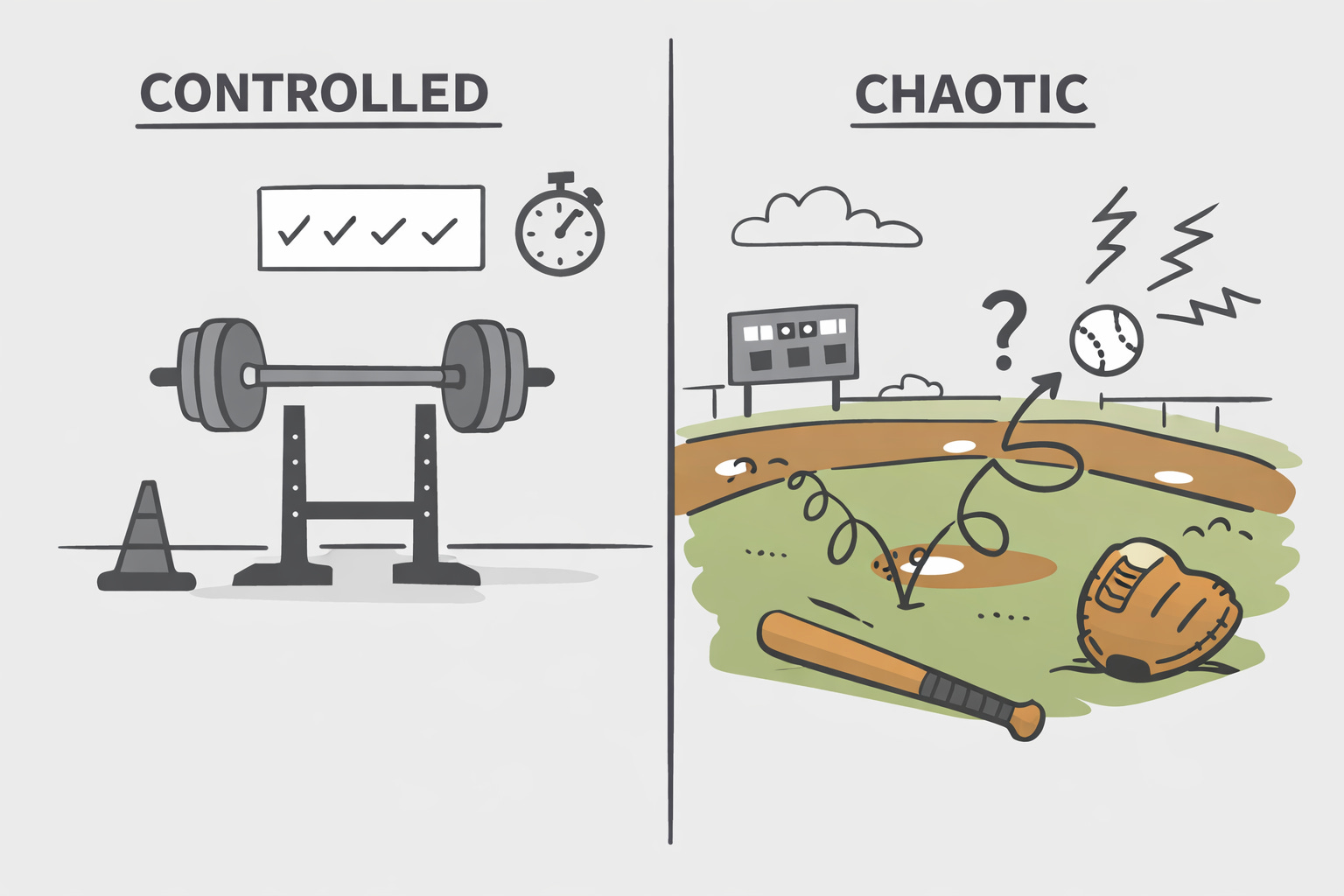
Optimization assumes the environment is stable.
But sport is anything but stable.
A shortstop doesn’t get the same hop twice.
A pitcher doesn’t throw from the exact same mound conditions every outing.
A hitter doesn’t face identical pitch shapes, speeds, or sequences.
Yet in training, we often strip all of that variability away.
We clean everything up:
Controlled reps
Predictable drills
Pre-planned movement patterns
The athlete gets really good at that version of the task.
But the game asks a different question:
Can you solve problems in real time when nothing is ideal?
Adaptability Is the Real Skill
At the highest levels, the separator isn’t who moves best in perfect conditions.
It’s who can adjust fastest when things go wrong.
Slightly late? Can you still get the barrel there?
Off-balance? Can you still make the play?
Timing disrupted? Can you still produce force effectively?
Adaptability isn’t just a byproduct of training—it has to be trained directly.
What This Looks Like in Practice
This doesn’t mean throwing structure out the window.
It means layering variability into it.
Instead of:
Repeating the same drill identically
Start introducing:
Small constraints (altered timing, spacing, or load)
Reactive elements (unpredictable cues)
Decision-making under fatigue
For example:
A hitter might train with mixed pitch types and variable timing
An infielder might field balls with randomized hops or angles
A pitcher might adjust intent or targets mid-sequence
Now the athlete isn’t just executing.
They’re solving.
Why This Matters Long-Term
Over-optimized athletes often plateau.
Not because they aren’t strong enough or fast enough—but because they’ve become fragile to change.
When something disrupts their pattern, performance drops sharply.
Adaptable athletes are different:
They maintain performance across environments
They recover faster from mistakes
They’re more resilient under pressure
In other words, they don’t just have capacity—they can use it anywhere.
A Simple Shift in Mindset
Instead of asking:
“What’s the perfect way to do this?”
Start asking:
“How many ways can you still succeed?”
That shift changes everything.
It moves training from: Memorizing movement
To: Building solutions
Final Thought
The game doesn’t reward perfection.
It rewards problem-solving at speed.
So yes—build strength.
Refine mechanics.
Develop outputs.
But don’t stop there.
Because the athletes who last—and perform when it matters most—aren’t the ones who are perfectly optimized.
They’re the ones who are adaptable enough to handle anything.